Identify Your Vision Problem
See an Eye-Care Professional First
A visit to an eye-care professional is the simplest way to identify your vision problem. Some professionals may not recommend vision exercises for refractive errors; for this site, the main purpose of the visit is to identify your vision problem and check whether the exercises are safe for you. You can ask specifically about those two things. This includes not only basic problems like nearsightedness or astigmatism, but also convergence problems, strabismus (including hidden forms), and amblyopia (commonly called lazy eye). Choose a professional who can perform a thorough exam and assess all of your vision problems.
During an eye examination, the doctor will usually also check the pressure inside your eyeball (intraocular pressure) and determine whether you have conditions such as glaucoma, cataracts, etc. If you have an atypical or severe vision problem, ask your eye-care professional if you can safely perform the exercises presented here.
Automated Vision Test
An eye-care professional will usually perform an automated vision test to make a preliminary assessment of your vision problem. During this examination, astigmatism in particular is measured accurately — usually more precisely than an examiner can estimate without equipment. It's best to choose a qualified optometrist or a reputable eye clinic to ensure that the equipment is current and properly calibrated and the results are as reliable as possible. However, even if the results deviate slightly from reality, that is not critical for our purposes, because we only want to know the approximate severity of the problem for the generator. We also advise against undergoing this type of examination too often just to check whether your vision has changed. The minimum interval should be six months, and preferably one year. You can track day-to-day changes at home with a Snellen chart under consistent lighting. Your comfort and your Snellen chart results can help you monitor changes between professional exams.
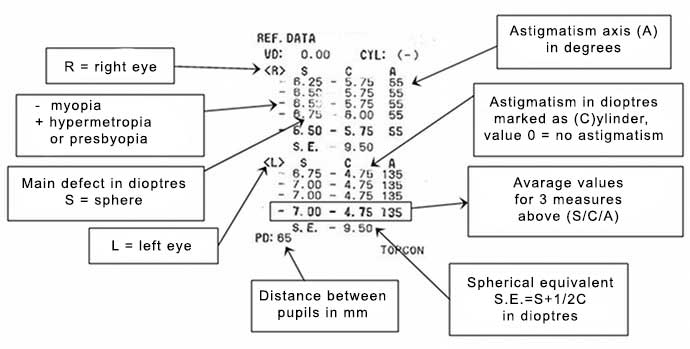
- Nearsightedness and its measurement in diopters (S column with a minus sign)
- Farsightedness or presbyopia and its measurement in diopters (S column with a plus sign)
- Astigmatism, its measurement in diopters (C column), and the axis in degrees (A column)
- Eye: (R) for the right eye or (L) for the left eye
- Distance between pupils in millimeters (PD mark)
- Average values of three measurements (S/C/A)
- Spherical equivalent (S.E.) = S + 1/2 C in diopters
Self-Assessment of Your Vision Problem
We strongly recommend using the professional options above, but the steps below can help you make a rough self-assessment. Remember that self-assessment of vision problems can be highly inaccurate. The goal is not a precise diagnosis, but only a rough sense of the type and severity of the problem, so you can use the generator to create an exercise plan.
Determining Your Primary Vision Problem
In many cases, it is fairly easy to identify your main vision problem. If you have trouble reading up close, you may have hyperopia (if you are under 40) or presbyopia (if you are over 40). If, however, your vision problems occur at long distances, and you have no trouble reading up close, you may have nearsightedness.
You can determine your main vision problem more accurately with a Snellen chart by placing it 6 meters (20 feet) away and trying to read the line of letters marked 6 m. If you can read this line at that distance, your distance vision is likely within the normal range. However, if you cannot read the letters in the 20/20 (6 m) row, check which row you can read. Say it's the row marked 20/40 (12 m): this means you already have mild nearsightedness — you can read from 6 m what eyes with standard 20/20 acuity read from 12 m. As a rough guide for the generator, the smallest row you can read indicates roughly: 20/25–20/40 mild nearsightedness, 20/50–20/70 moderate nearsightedness, and 20/100–20/200 severe nearsightedness.
Perform the test above with each eye separately to find the difference between the two eyes. If the difference is large — greater than one row on the chart — this may indicate amblyopia, commonly called lazy eye.
Determining Astigmatism
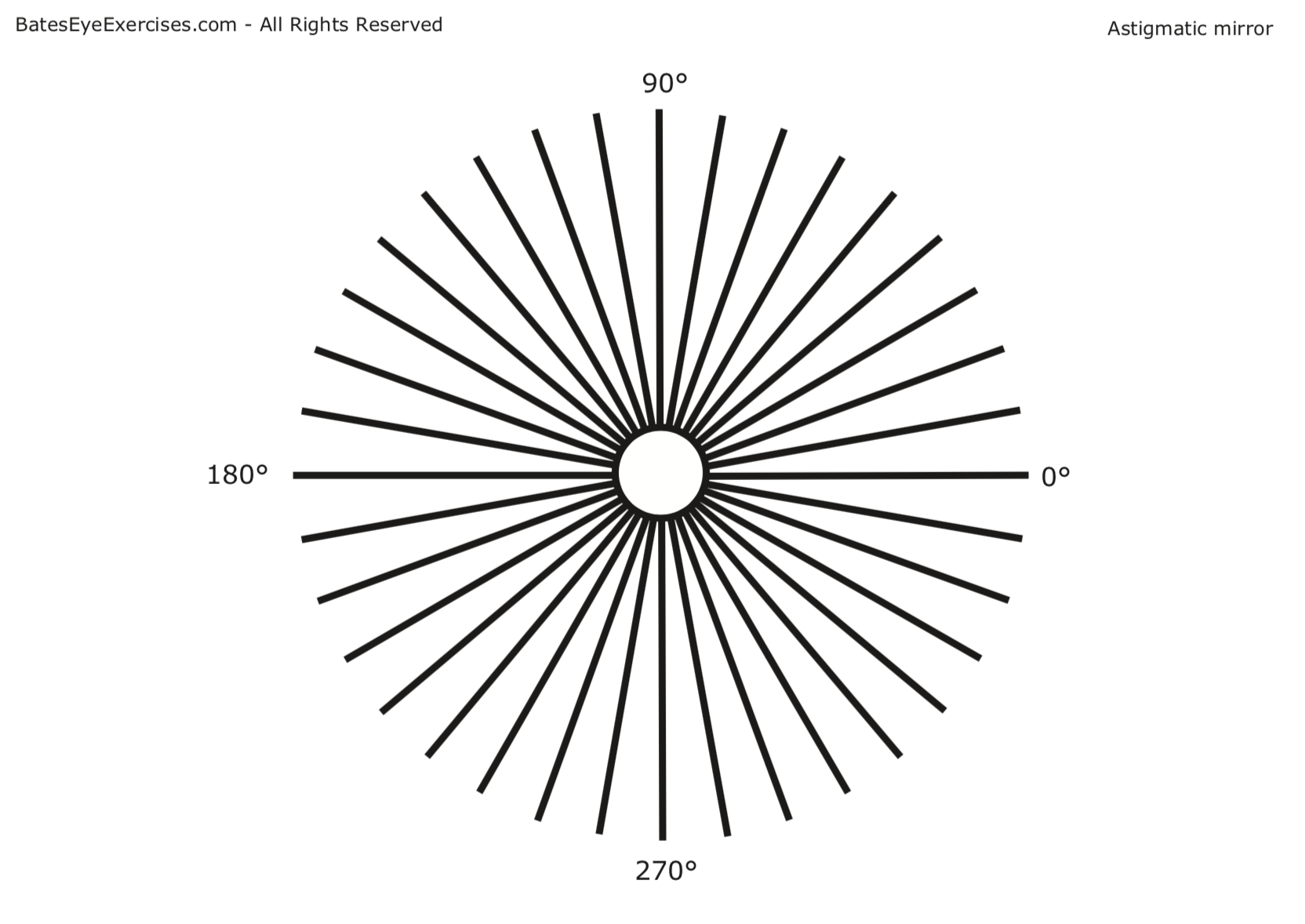
To check for astigmatism, use the "astigmatic dial" image. View it on a monitor or a printed chart from a distance where you can see the lines clearly. If you have astigmatism, some lines will look darker, thicker, or more sharply defined than the others. If all the lines look equally even and equally black, astigmatism is less likely to be your main concern. Now look at the astigmatic dial from different distances, as some people have astigmatism only at certain distances. Choose a distance at which the image is otherwise sharp; results outside that range are unreliable.
The astigmatic dial is also useful for tracking your progress against astigmatism. You can use it after each astigmatism exercise to see how the exercise affects the quality of your vision.
Assessing Eye Convergence Problems
To check for eye convergence problems, you can use a string or elastic cord.
To check whether your eyes converge properly, attach one end of the string to a door, for example, and hold the other end at the tip of your nose so that the string is taut. Place a few markers (e.g., beads) on the string, at equal distances. When you look at any bead, you should see phantom lines that cross exactly where the bead is. Some people see these phantom lines with the bead as an X, others as a Y or an A. The shape is not as important as the fact that the lines should converge perfectly at the bead's location. If the lines converge before or behind the bead, you have an issue with eye convergence.
Now look at the next beads, each time checking the point of eye convergence. If the phantom lines converge perfectly at the bead in every position, eye convergence problems are less likely to affect you. If you did notice a problem, don't be discouraged: convergence can be improved effectively through exercises, which we highly encourage.
The test described here is also a good way to check whether your convergence exercises are working and how quickly your vision is returning to normal.
Determining Strabismus
A large strabismus is obvious enough that recognizing it is no problem. For proper exercise, it is important to determine the type of strabismus — that is, the direction in which the eye deviates. With small deviations or hidden strabismus, the affected person is often unaware of the condition. Everyone should therefore be checked for it, as early detection usually means easier and faster care.
It is easiest to assess this with the help of another person, who can readily tell whether one of your eyes deviates, veering off to one side. For the test, it's best to use a book or a card, asking the person being tested to look at a specific word or letter. Place it about 20 cm from the person's face and gradually move it away. At each distance, carefully observe whether the eyes are convergent and whether one of them shows strabismus.
You can also use the cover test: alternately cover the left and right eye, preferably with a square piece of paper, moving it slowly from one side to the other. In hidden strabismus, the deviating eye reveals itself the moment it loses binocular vision — watch the eye closely as the paper slides off it, and you may catch it drifting back into alignment.